
BeepBeep Casino Registration & KYC: Account Setup and Verification
 Available in AU
Contents
BeepBeep is an 18+ service, and the current official KYC policy makes verification a practical part of account setup rather than something to think about only after a problem. Full KYC is required when lifetime deposits exceed EUR 2,000, when you request a withdrawal of any amount, or when additional security or risk checks require it. The standard evidence starts with a government-issued photo ID and recent proof of address. A selfie with the ID can be requested, and extra payment-method, source-of-funds, source-of-wealth or liveness checks can also be required.
The operator says its KYC team aims to review submitted documents within 24 hours. That is a review target, not a promise of approval or completed withdrawal within one day. The useful registration strategy is simple: enter accurate account details, make sure those details will match your evidence, keep the official KYC requirements in mind before depositing, and expect verification to be completed before any cashout.
The account-to-withdrawal sequence
- Start with accurate personal information. The official KYC policy says information supplied during registration and verification must be accurate and truthful. Treat your account name, address and other identity details as data that later needs to agree with your documents.
- Confirm the 18+ requirement. BeepBeep publishes an 18+ policy. Identity evidence used during KYC must confirm that the account holder is at least 18.
- Review payment and bonus conditions before funding. Registration is only the account-opening stage. Cashier methods, bonus rules and withdrawal prerequisites are separate conditions that can affect what happens later.
- Prepare for KYC before the first withdrawal. Any withdrawal amount triggers full KYC under the current policy, so verification is not limited to high-value cashouts.
- Respond to any extra verification request. The operator can request more evidence where security, AML or compliance checks require it.
This sequence is more useful than treating registration as a one-minute form and KYC as a later surprise. A mismatch created at account opening can become a verification problem at the point when you want to withdraw, which is the least convenient time to discover that an address, name or identity detail needs clarification.
When full KYC is required
The current official KYC policy lists three clear triggers. Full verification is required after lifetime deposits exceed EUR 2,000, on a withdrawal request of any amount, and when additional verification is required because of security or risk checks. The policy also says verification can be requested earlier where necessary.
| Trigger | Current operator position | Practical effect |
|---|---|---|
| Lifetime deposits exceed EUR 2,000 | Full KYC required | Verification can become mandatory before you are planning a withdrawal. |
| Withdrawal of any amount | Full KYC required | There is no small-withdrawal exception in the current KYC wording. |
| Security or risk check | Additional verification can be required | The operator can ask for KYC earlier based on account circumstances. |
The EUR 2,000 threshold is the operator’s global policy threshold and is not an AUD conversion for this page. This site does not convert that figure because the source itself states it in euros. For an Australian reader, the more immediate planning point is that every withdrawal is a KYC trigger regardless of the cashout amount.
What documents the current policy lists
The official policy lists a government-issued photo ID as proof of identity. Examples given by the operator include a passport, national ID card or driving licence. The document must belong to the account holder, match the account details, clearly show the holder’s name, photograph and date of birth, confirm that the holder is at least 18, and remain valid under the policy’s document rules.
For proof of address, the policy lists a bank statement or utility bill issued within the last three months. It must show the account holder’s full name and residential address and match the information recorded on the casino account. This is why registration accuracy matters: verification is not only about possessing a valid document, but also about whether the submitted evidence matches the profile.
A selfie holding the identification document can also be requested. The operator says the face and document must be clearly visible and the ID must match the identity document already submitted for verification. These are the standard categories published now, but they are not an exhaustive ceiling on what the operator can request.
Enhanced checks can go beyond ID and address
The KYC policy explicitly reserves additional verification for some cases. It lists extra proof of identity or address, payment-method verification, source-of-funds or source-of-wealth documentation, and additional identity or liveness checks as possible requests.
That distinction matters because a complete-looking first document upload does not guarantee that the review is finished. An account can require further evidence because of the payment route, transaction history, security concerns or other compliance checks. The correct preparation is not to guess which extra document will be requested. Keep account data consistent, retain records that explain how you funded the account, and respond to the specific request shown by the operator.
This page therefore does not present one universal checklist as a guaranteed final list. It presents the current published baseline and the operator’s own statement that additional evidence can be required.
What the 24-hour KYC wording means
After documents are submitted, BeepBeep says an account can receive a temporarily approved status while the KYC team reviews the information. During that period, the platform can remain usable, but withdrawals cannot be completed. The operator says its KYC team aims to review documents within 24 hours.
The important word is “aims”. A 24-hour review target is not the same as guaranteed approval. The KYC result can be approved, rejected, or a request for more information. If the image is unclear, the account details do not match, or an enhanced check is needed, the process can continue beyond the first review window.
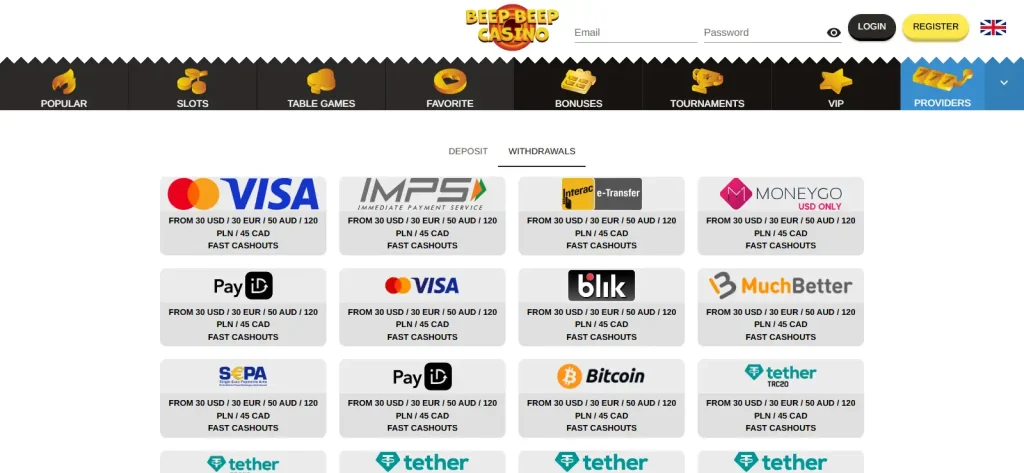
It is also separate from withdrawal processing. Even after identity review is complete, a cashout can still be affected by the payment route and the operator’s withdrawal prerequisites. The cashout process owns the current withdrawal timing, turnover and limit details so the two timelines are not confused.
Registration details should be verification-ready
The KYC policy says registration and verification information must be accurate and truthful. That provides a practical rule for opening the account: use details that can be supported by your real identity documents and current proof of address. Do not treat a nickname, old address or approximate date as harmless profile information if the same fields will later be checked against evidence.
Before depositing, review the account profile for obvious mismatches. If your address has recently changed, make sure the proof you plan to use is current and corresponds with the account record. If your ID uses a different version of your name, do not assume the discrepancy will be ignored. Resolve account-data questions through support before they become attached to a withdrawal request.
For funding choices, use the AUD payments rather than assuming an Australian payment method is supported just because it is common locally. Payment availability is an account and cashier fact, while KYC is an identity and compliance process.
Support routes for registration and KYC problems
BeepBeep’s verified support email is [email protected]. Current independent sources also consistently report 24/7 live chat with English support. This page does not promise a fixed chat response time because current published tests do not agree on one.
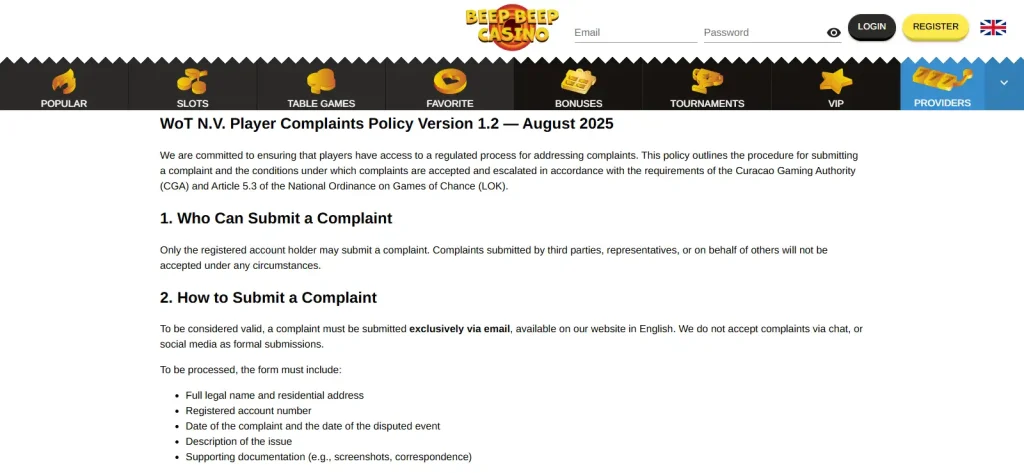
If a verification disagreement becomes a formal complaint, the KYC complaints explains the operator’s escalation route. Live chat can be useful for troubleshooting, but the formal complaints process has its own submission requirements.
Australia access and regulation are separate from account verification
A working registration or account flow should not be read as evidence of Australian regulatory approval. Operational access and local authorisation are separate questions, so availability does not establish an Australian licence or regulatory status.
For the legal and regulatory layer, use the trust and licence. It separates the operator’s Curaçao licence from the Australian provider-side framework and from the question of whether the current casino terms list Australia as generally restricted. Keeping those layers separate prevents a working registration or cashier flow from being mistaken for an Australian licence.
Pre-withdrawal KYC readiness checklist
- Account details: make sure your name, address and other identity information are accurate and match the evidence you plan to use.
- Age: the site is 18+, and the identity document must support the age requirement.
- Photo ID: use a valid government-issued document that meets the current policy requirements.
- Proof of address: prepare a recent bank statement or utility bill that shows the same residential address as the account.
- Image quality: make sure required information is readable and the complete relevant document area is visible.
- Extra evidence: be prepared for payment, source-of-funds, source-of-wealth or liveness checks if requested.
- Timing: treat 24 hours as the KYC team’s review aim, not an approval guarantee.
- Records: keep important messages and submission details if you need to follow up with support.
How to reduce avoidable verification friction
KYC is easier to manage when the account record, payment ownership and submitted identity evidence tell the same story. Before sending documents, check that the file is readable, the name and residential details match the account, and the document is the type currently requested. If support asks for a different or additional item, follow that request rather than repeatedly uploading the same file.
Keep verification and gambling decisions separate. Completing KYC does not make a deposit, bonus or withdrawal automatically suitable for you, and it does not change the Australian regulatory position. Verification is an identity and compliance step. Payment choices, promotion conditions and licensing questions each have their own rules and should be checked in the relevant guide.
Bottom line
The Australia review covers the broader casino, but registration and KYC are easiest to manage when treated as one account journey. Open the account with accurate information, remember the 18+ requirement, and expect full KYC before any withdrawal. The current policy also triggers full verification above EUR 2,000 in lifetime deposits or when risk and security checks require it.
The baseline evidence is government-issued photo ID plus recent proof of address, with a selfie and additional payment, source-of-funds, source-of-wealth or liveness checks possible. BeepBeep says its KYC team aims to review documents within 24 hours, but approval can take longer if more information is needed. The practical advantage of preparing early is not that verification disappears; it is that the identity and account data are already consistent when the withdrawal trigger arrives.
This material was created by the BeepBeep Australia Guide team.
Related posts
BeepBeep Casino Complaints: Process, ADR & Reputation Signals
BeepBeep Casino Withdrawals: Limits, Timing, KYC & Cashout Rules